


Pain Points of the Business Customer
- High Error Rate
- Long Turn Around Time (TAT)
- Inefficiency in Handling Bulk Requests
- Lack of Automation
- Difficulty in Managing Multiple Numbers
- Limited Flexibility
Thousands of SIM activations, processed through email chains and manual data entry across three disconnected systems. One invalid record was enough to restart the entire batch.
Reduced batch creation and submission time by half using a template-based system.
0 operators
Required for Batch creation, request submission and error validation.
Redesigned the fully manual experience with a single self-service flow.
-48hrs → 0
From days to seconds Batch activations of up to 500 SIMs now confirm within the session — replacing a process where operators waited days for email confirmation with no visibility in between.
Omantel is Oman's national telecom provider. Work spanned a B2C eShop and a B2B bulk activation platform: enterprise customers need to activate, modify, or deactivate SIM services in bulk — hundreds of records at a time, governed by strict eligibility and credit rules.
The existing process ran entirely on email. A company rep would send a request to the Omantel team, who would manually verify details against a separate backend system, re-enter the data into the portal, generate the batch — and discover errors only after submission. Every request meant tab-switching between email, the backend, and the portal. Every error meant starting over.
There was no defined scope for research, as the vision was pre-defined from the business side.
A company rep emails Omantel. An internal team member opens the mail, switches to a backend system to verify eligibility, switches to the portal to manually enter data, generates the batch — and discovers errors only after submission. Invalid records restart the process. Every bulk request requires staff time.
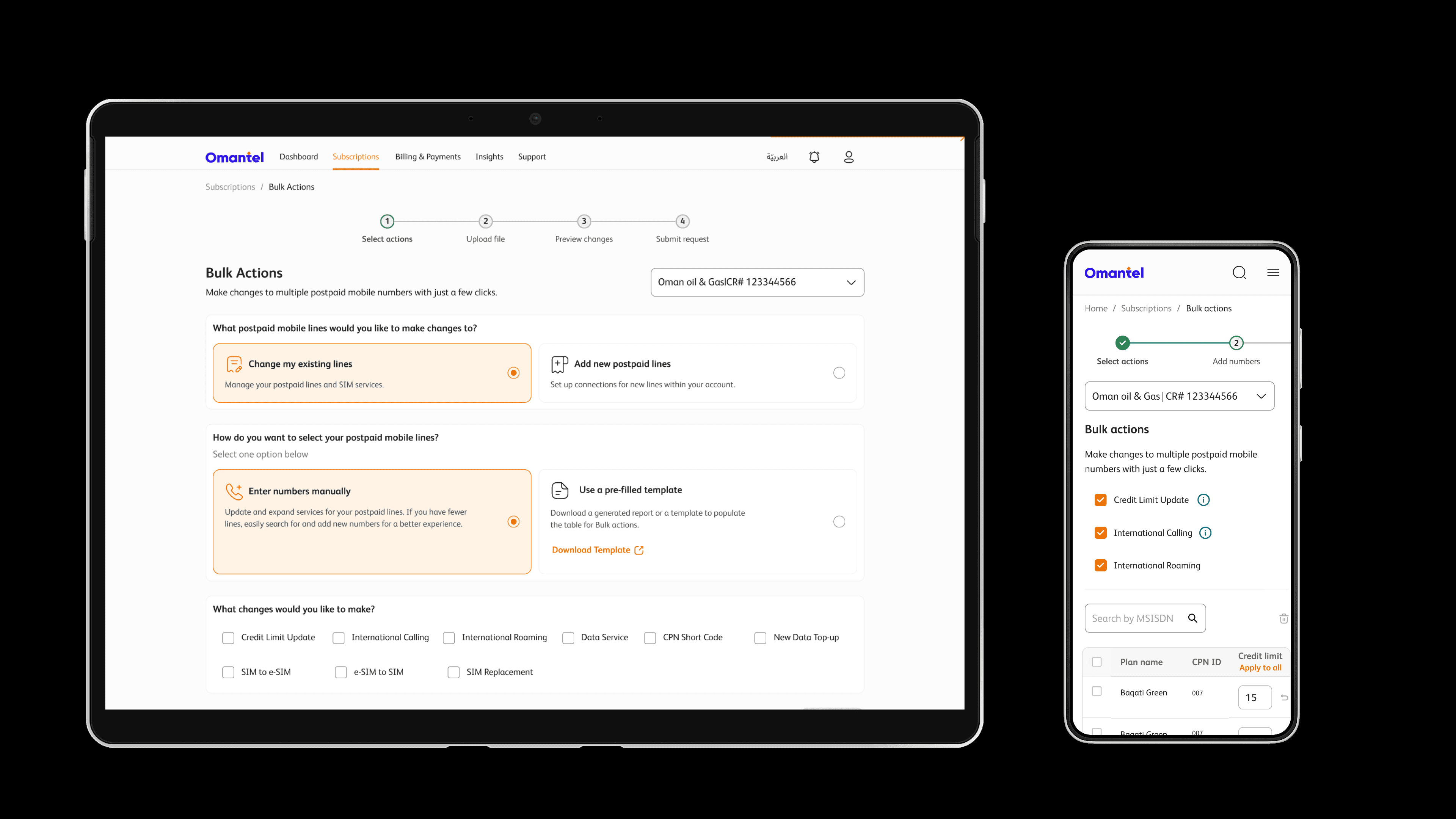
The company rep submits directly. Eligibility and credit limits validate inline, before the batch is created. Errors surface at the point of entry, not after failure.
We were dealing with two sets of pain points — Omantel's and their business customers. It took some discussions to understand what a typical B2B telco journey looks like.
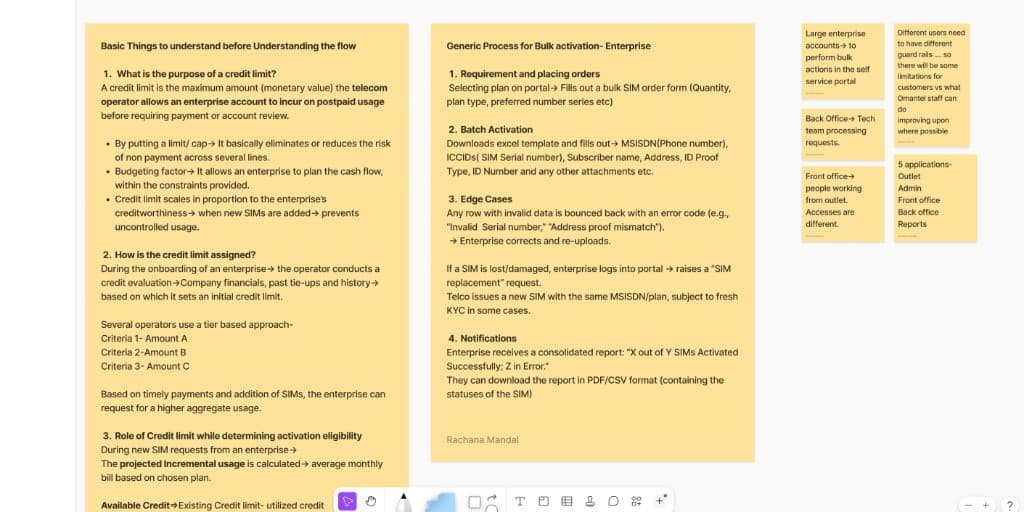

A walkthrough of the entire manual process from Omantel's staff allowed us to put ourselves in their shoes, gather a better understanding of their pain points in the journey. They were juggling between three different platforms — a back office, a CRM, the customers mails.

Two input paths in one interface: CSV templates for bulk preparation offline, and a search-and-modify flow for quick single-record changes.

In the manual process, a single invalid entry could fail the entire batch and the operator would have to go through the entire process again. The users would receive confirmation regarding batch submission in a span of 48-72hrs.

Enterprise users need to return later to verify outcomes or explain changes internally. A unified history view was designed to surface: overall batch status, individual order status within a batch, mixed outcomes when a batch contained both completed and in-progress requests.

The experience needed to work across devices, but presenting hundreds of records on mobile risked turning simplification into confusion. Mobile was intentionally scoped to: creating or requesting new lines, updating a small number of known lines via manual search. High-volume bulk updates remained desktop-only, supported through structured CSV templates.

Using outdated/ invalid data to place batch requests can be a very costly mistake. To make it easy for enterprise reps to keep track of the latest data (associated with the numbers)- a logic was set for the system to self validate the data and prompt the user based on the same.

To me this project was a good example of what proactive collaboration should look like.


